Theory of Machines Miscellaneous
- Match the following with respect to spatial mechanisms.
Type of Joint Degrees of constraint P. Revolute 1. Three Q. Cylindrical 2. Five R. Spherical 3. Four wire 4. Two 5. Zero
-
View Hint View Answer Discuss in Forum
For revolute joint, degree of freedom = 1
For cylinderical joing, degree of freedom = 2
For spherical joint, degree of freedom = 3
Degree of constraints = 6 – Degree of freedomCorrect Option: C
For revolute joint, degree of freedom = 1
For cylinderical joing, degree of freedom = 2
For spherical joint, degree of freedom = 3
Degree of constraints = 6 – Degree of freedom
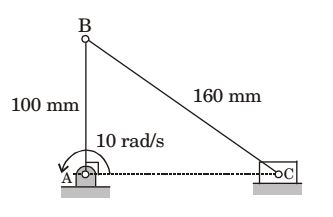
- In a slider-crank mechanism, the lengths of the crank and the connecting rod are 100 mm and 160 mm, respectively. The crank is rotating with an angular velocity of 10 radian/s counter clockwise. The magnitude of linear velocity (in m/s) of the piston at the instant corresponding to the configuration shown in the figure is ___.
-
View Hint View Answer Discuss in Forum
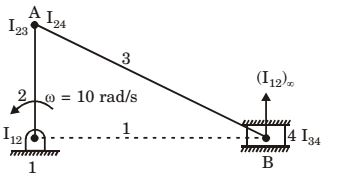
ω2(I24 I12) = V4 = VB
VB = ω2 (I24 I12) = 10 × 0.1
VB = 1 m/sCorrect Option: A
ω2(I24 I12) = V4 = VB
VB = ω2 (I24 I12) = 10 × 0.1
VB = 1 m/s
- The lengths of the links of a 4-bar linkage with revolute pairs only are p, q, r and s units. Given that p < q< r< s. Which of these links should be the fixed one, for obtaining a "double crank" mechanism?
-
View Hint View Answer Discuss in Forum
To obtain a “DOUBLE CRANK MECHANISM” shortest link is always fixed. While obtaining a “DOUBLE LEVER MECHANISM”, the link opposite to the “SHORTEST LINK” is fixed.
Correct Option: A
To obtain a “DOUBLE CRANK MECHANISM” shortest link is always fixed. While obtaining a “DOUBLE LEVER MECHANISM”, the link opposite to the “SHORTEST LINK” is fixed.
- For an inline slider-crank mechanism, the length of the crank and connecting rod are 3 m and 4 m, respectively. At the instant when the connecting rod is perpendicular to the crank, if the velocity of the slider is 1 m/s, the magnitude of angular velocity (upto 3 decimal points accuracy) of the crank is ______ radian/s.
-
View Hint View Answer Discuss in Forum
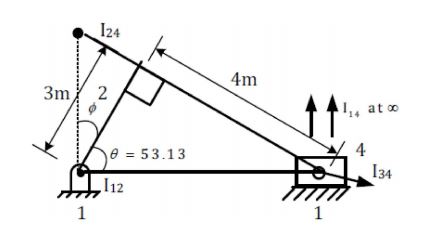
Here, tanθ = Perpendicular Hypotenuse tanθ = 4 3
⇒ θ = 53.13
φ = 90 – θ = 36.87Cosφ = 3 I12 - I24 Cos36.87 = 3 I12 - I24
I12 - I24 = 3.75
VI24 = velocity of slider
= ω2 (I12 - I24)
I = ω2 × 3.75
ω2 = 0.267 radian/secondCorrect Option: C
Here, tanθ = Perpendicular Hypotenuse tanθ = 4 3
⇒ θ = 53.13
φ = 90 – θ = 36.87Cosφ = 3 I12 - I24 Cos36.87 = 3 I12 - I24
I12 - I24 = 3.75
VI24 = velocity of slider
= ω2 (I12 - I24)
I = ω2 × 3.75
ω2 = 0.267 radian/second
- For a certain engine having an average speed of 1200 rpm, a flywheel approximated as a solid disc, is required for keeping the fluctuation of speed within 2% about the average speed. The fluctuation of kinetic energy per cycle is found to be 2 kJ. What is the least possible mass of the flywheel if its diameter is not to exceed 1 m?
-
View Hint View Answer Discuss in Forum
Average speed, N = 1200 rpm
Co-efficient of fluctuation of speed= Cs = ω1 - ω2 = 2% = 0.02 ω
Fluctuation of kinetic energy = ΔE = 2 × 10³JNow, ΔE = 1 Iω²1 - 1 Iω²2 = 1 I(ω²1 - ω²2) 2 2 2 Since ω1 + ω2 = ω 2 = I 
ω1 + ω2 
(ω1 - ω2) ω Iω (ω1 + ω2) .ω ω
= Iω²cs.⇒ 2 × 10² = 1 MR².ω².C²s 2
where R = Radius of disc= 1 M × 1 ² × 2176200 × 0.02 2 2 60 ∴ M = 2 × 10³ × 60 × 60 × 8 0.02 × (2 × π × 1200)²
= 50.65 ≈ 51 kg.Correct Option: B
Average speed, N = 1200 rpm
Co-efficient of fluctuation of speed= Cs = ω1 - ω2 = 2% = 0.02 ω
Fluctuation of kinetic energy = ΔE = 2 × 10³JNow, ΔE = 1 Iω²1 - 1 Iω²2 = 1 I(ω²1 - ω²2) 2 2 2 Since ω1 + ω2 = ω 2 = I ω1 + ω2 (ω1 - ω2) ω Iω (ω1 + ω2) .ω ω
= Iω²cs.⇒ 2 × 10² = 1 MR².ω².C²s 2
where R = Radius of disc= 1 M × 1 ² × 2176200 × 0.02 2 2 60 ∴ M = 2 × 10³ × 60 × 60 × 8 0.02 × (2 × π × 1200)²
= 50.65 ≈ 51 kg.

